Separate Legal Entities
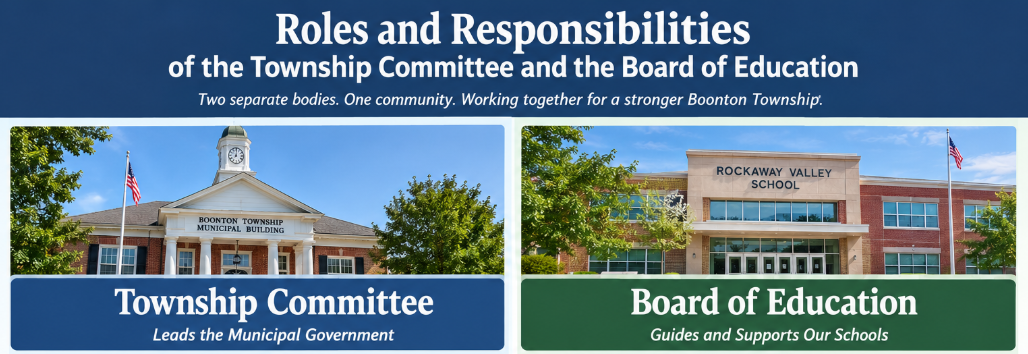
The Township Committee and Board of Education are two separate entities governed by their own statutes - Title 40/40A for Township/County and Title 18A for Schools and each answers to separate State agencies. Neither has control over the other.
Rockaway Valley School is run by the Board of Education. The Township Committee has no input or control on how the Board operates or spends its tax dollars. 68% of your property taxes fund the school - that amount is determined by the Board of Education budget. The Township Committee’s portion of your property taxes fund is 20% (general purpose 19% and open space 1%) and that rate has increased by less than one percent (.84%) over the past five years.
The Township collects taxes for the school and county but otherwise has no control over its finances or financial decisions which are the sole responsibility of the Board of Education.
Funding Capital Projects
Under New Jersey law, funding capital projects (long-term infrastructure like building additions, road paving, emergency equipment, or new school construction) works very differently for municipalities versus school districts. Any school district seeking to issue new bonds to build new facilities, renovate aging buildings, upgrade HVAC systems, or improve school security must secure voter consent via a ballot question while municipalities finance long-term infrastructure (like roads, buildings, and utilities) through the Municipal Capital Fund whose voter approval is not required by Statute.
While both entities rely heavily on issuing long-term municipal debt (bonds), the approval pathways, statutory restrictions, and state funding mechanisms are distinct.
Core Comparison of Capital Project Funding
| Feature | Municipal Capital Projects | School District Capital Projects |
| Primary Statutory Framework | Local Bond Law (N.J.S.A. 40A:2) | Educational Facilities Construction & Financing Act (N.J.S.A. 18A:7G) |
| Voter Approval Requirement | Not required (Passes by township committee ordinance) | Required via public referendum (for Type II districts) |
| Mandatory Cash Down Payment | 5% down payment required from current funds or reserves | None required (can finance 100% of local share) |
| State Aid / Grant Potential | Limited (DOT grants, state/federal aid, discretionary grants) | State Debt Service Aid (covers at least 40% of eligible costs) |
| Debt Limit Cap | 3.5% of the municipality's equalized valuation | 2.5% to 4% of equalized valuation (varies by grade levels served) |